Beyond Basic Blackletter: Using a Tattoo Font Generator to Design Delicate Skeletal Gothic Script for Finger Tattoos

The evolution of tattoo culture has shifted from bold, traditional motifs to a sophisticated emphasis on micro-details and precision. Among the most enduring yet challenging styles is Gothic script. Often characterized by its heavy, „blackletter” appearance, traditional Gothic fonts present a significant risk for specific body placements—especially the fingers and hands. As ink ages, the skin’s natural expansion causes dense lettering to blur, often resulting in what artists call a „black blob.” To solve this, a modern tattoo font generator powered by AI has become the essential bridge between historical aesthetics and biological reality.
The Evolution of Gothic Script: From Manuscripts to Finger Art
Gothic script, or Blackletter, originated in the mid-12th century as a way to maximize the amount of text on expensive parchment. It was intentionally dense, dramatic, and thick. When translated to skin, these same characteristics become a liability. Finger tattoos are notorious for „blowouts”—where the ink spreads into deeper layers of skin—and fading due to constant movement and sun exposure.
The primary user pain point today is finding a balance: users want the dark, rebellious soul of Gothic lettering without the structural heaviness that ruins a small-scale tattoo over time. This is where a specialized tattoo font generator changes the game. Unlike standard word processors or static font sites, an AI-driven tool allows for the creation of „Skeletal Gothic”—a style that strips the letterforms down to their elegant, bony essence.
Why Traditional Fonts Fail for Micro-Placements
When you download a standard Gothic font, you are usually getting a design meant for print or digital screens. These environments are static. Skin, however, is a living organ.
- Ink Spread (The Blob Factor): Every tattoo spreads slightly over 5 to 10 years. In a dense font, the negative space (the white parts inside letters like 'e’, 'a’, or 'g’) disappears.
- Skin Texture on Fingers: Finger skin is thin and moves constantly. Thick lines tend to look „muddy” much faster than fine lines.
- The „Heavy” Aesthetic vs. Elegance: Modern trends lean toward „Fineline” aesthetics. A heavy Old English font on a delicate finger can feel overwhelming and clumsy rather than intentional.
By utilizing a high-precision tattoo font generator, users can manipulate the weight of the strokes to ensure that the „skeletal” structure of the letter remains legible even after a decade of skin aging.
Designing the „Skeletal Gothic” Look with AI
The hallmark of a superior tattoo font generator is its ability to offer „Expressive Control.” It isn’t just about picking a font; it’s about refining the architecture of the word. For finger tattoos, we focus on three pillars of design:
1. Line Precision and Kerning (Spacing)
In Gothic design, letters are often placed close together to create a „picket fence” effect. For a finger tattoo, this is a recipe for disaster. An AI generator allows you to increase the kerning—the space between individual letters—ensuring that each character has enough „breathing room” to survive the natural ink spread.
2. Deconstructing the Stroke
Skeletal Gothic focuses on the „spine” of the letter. Instead of a thick, flat-edge nib look, the AI generates tapered ends and needle-thin connectors. This mimics the appearance of bone or delicate ironwork, providing a gothic vibe that feels high-fashion and sophisticated.
3. Visual Symmetry
Because fingers are narrow, the verticality of the font is crucial. A tattoo font generator allows you to preview how a word like „LOYALTY” or „FAITH” stacks vertically or wraps around the phalanx. The AI ensures that the proportions remain consistent across different characters, which is nearly impossible to do by hand without a professional digital aid.
The Technical Advantage of Refont’s AI Engine
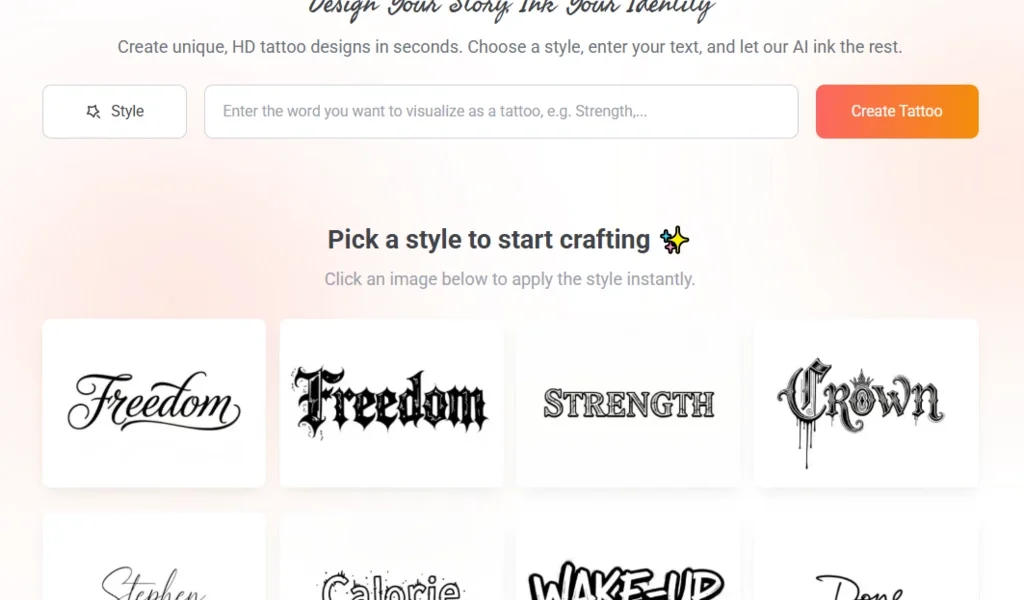
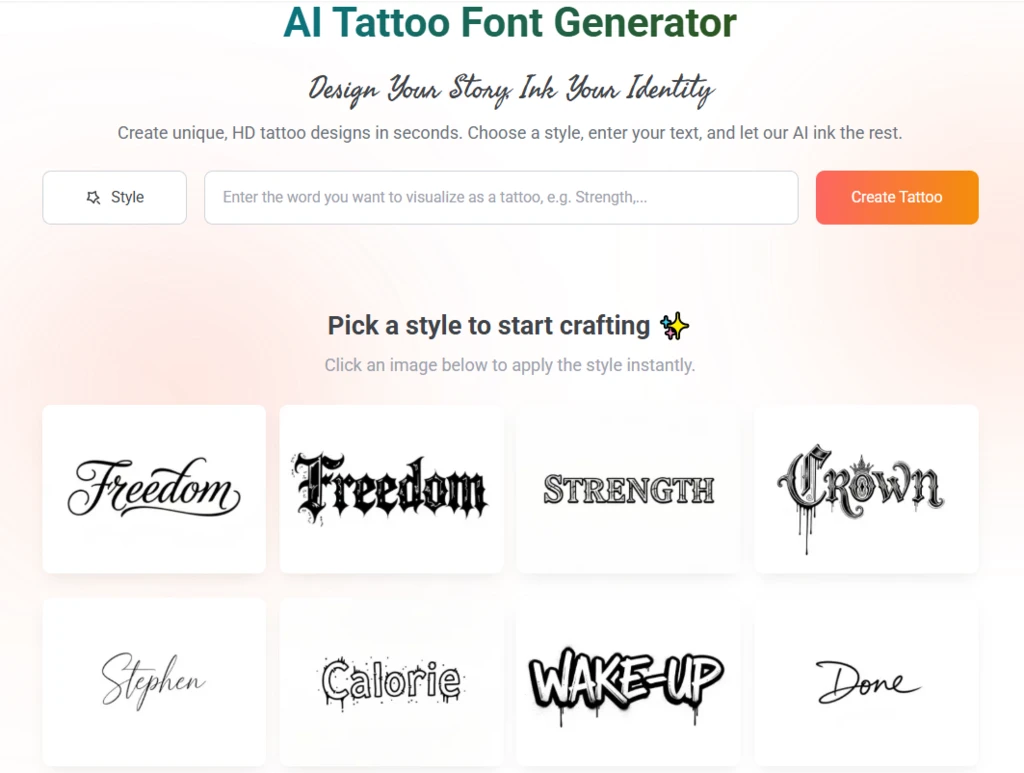
What sets Refont apart in the crowded space of design tools is its focus on expressive individuality. Most generators simply pull from a library of pre-existing Google fonts. Refont’s AI understands the „anatomy” of a signature and a calligraphy stroke.
When a user inputs a word, the AI doesn’t just display it; it calculates the optimal weight for visual attraction. For someone looking for a „Gothic Skeletal” look, the tool can generate variations that emphasize the sharp, jagged edges typical of the style while maintaining a „fine-line” thickness. This level of customization ensures that the final design is „tattoo-ready,” saving the tattoo artist hours of redesigning and ensuring the client gets exactly what they saw on the screen.
Strategic Planning for Your Finger Tattoo
If you are planning to use a tattoo font generator for your next piece, follow this expert workflow to ensure longevity and style:
- Step 1: Choose Your Word Wisely. Short words (3-7 letters) work best for fingers. Long words require the font to be shrunk, which increases the risk of blurring.
- Step 2: Test the Weight. Use the generator to toggle between „Bold,” „Regular,” and „Light.” For fingers, „Light” or „Extra Fine” is almost always the better long-term choice.
- Step 3: Export as a High-Res Stencil. A major pain point for tattoo artists is being handed a blurry screenshot. A professional generator provides a clean, high-resolution output that can be used directly for the transfer stencil.
- Step 4: Consult the „Ink Blowout” Preview. Look at the design and imagine each line becoming 10% thicker. If the holes in the letters disappear, go back to the generator and increase the spacing.
Beyond Fingers: The Versatility of Skeletal Gothic
While this guide focuses on fingers, the skeletal Gothic style is gaining massive traction for „Spine Tattoos” and „Sternum Pieces.” These areas demand a certain „flow” that follows the bone structure of the body. A standard font is too rigid. An AI-driven script can be adjusted to curve or taper, mimicking the organic lines of the human skeleton.
The beauty of using a tattoo font generator is the ability to experiment without commitment. You can generate fifty variations of a single word in seconds—changing the „flourish” of a 'G’ or the „descender” of a 'y’—until the typography feels like a natural extension of your body.
Final Thoughts: The Future of Body Art Design
Tattooing is a permanent decision, yet the design process has historically been remarkably primitive. For decades, clients chose from „Flash Books” on a shop wall. Today, we are in the era of personalization.
Tools like Refont are democratizing high-end design. You no longer need to be a professional typographer to understand how a Gothic 'S’ should look on a knuckle. By leveraging an AI tattoo font generator, you are taking control of your body art’s legacy. You are moving beyond the „basic blackletter” and into a realm of delicate, skeletal precision that respects both the history of the script and the biology of your skin.
Whether you are a tattoo artist looking to provide better options for your clients, or an enthusiast planning your first micro-tattoo, the message is clear: don’t settle for „standard.” Use the technology available to design a piece that is as unique as your own signature—sharp, refined, and built to last a lifetime.

7 najczęstszych błędów przy urządzaniu małego mieszkania – jak ich uniknąć i nie stracić przestrzeni Małe mieszkanie może być funkcjonalne, Czytaj dalej

Gdybyś kilka lat temu powiedział komuś, że w 2025 r. przedpłacone vouchery będą jednym z najpopularniejszych sposobów płatności online, ta Czytaj dalej